
As a dedicated gamer who's spent countless hours exploring the mysteries of Kojima's universe, I recently dove deep into the technical wizardry behind Death Stranding 2: On the Beach's implementation of PlayStation 5's Power Saver Mode. What I discovered is far more intriguing than a simple performance trade-off—it might be our first glimpse into Sony's portable gaming ambitions.
Understanding PlayStation 5's Power Saver Innovation
For those unfamiliar, Power Saver Mode represents a significant technical achievement for the PS5. This operating mode essentially transforms the console's capabilities by cutting CPU resources in half, reducing memory bandwidth by 50%, and throttling both CPU and GPU clock speeds. The primary goal? Dramatically reducing power consumption while maintaining playable experiences.
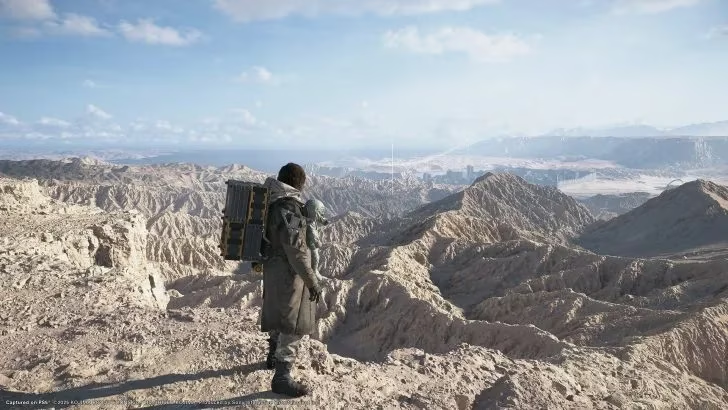
When I first tested this mode, I was skeptical. How could a game as visually stunning as Death Stranding 2 possibly function with such severe hardware limitations? But Kojima Productions has pulled off something remarkable.
Death Stranding 2's Clever Technical Implementation
What makes Death Stranding 2's approach fascinating is how the development team worked around these constraints. At first glance, the implementation appears straightforward—the game runs in Performance Mode while capping the framerate at 30 fps. However, the devil is in the details, and that's where things get really interesting. 🎮
Technical Specifications Breakdown
| Feature | Quality Mode | Performance Mode | Power Saver Mode |
|---|---|---|---|
| Frame Rate | 30 fps | 60 fps | 30 fps (capped) |
| Resolution | Higher | Lower | ~1440p (dynamic) |
| Tessellation | Maximum | Reduced | Quality Mode level |
| Geometry Detail | Maximum | Reduced | Quality Mode level |
What surprised me most during my gameplay sessions was the visual fidelity. Despite operating under severe hardware constraints, Kojima Productions maintained tessellation and geometry details equivalent to Quality Mode. The resolution stabilizes around 1440p with dynamic scaling active, ensuring the game adapts to demanding scenes without compromising too heavily on visual clarity.
This hybrid approach demonstrates incredible technical sophistication. Rather than simply downgrading everything proportionally, the team selectively enhanced certain visual elements while accepting the 30 fps limitation imposed by CPU constraints. In some instances, Power Saver Mode actually delivers better visual fidelity than standard Performance Mode—a truly unexpected outcome! ✨
Comparing the Two Death Stranding Titles
The contrast between the two games' implementations reveals a lot about development priorities. Death Stranding: Director's Cut, being an enhanced port of a PS4 title, had a relatively straightforward path to Power Saver support. The game was already designed to run on less powerful hardware, making the adaptation process less challenging.
Death Stranding 2, however, was built specifically for PS5's capabilities. Scaling it back while maintaining the experience Kojima envisioned required significantly more creative problem-solving. The result is a testament to the Decima Engine's flexibility and the team's technical prowess.
The Portable PlayStation Question 🎯
Here's where my analysis gets really interesting. After extensive testing, I'm convinced that Power Saver Mode isn't primarily about energy conservation for stationary consoles—it's preparation work for something bigger.
The rumored PlayStation handheld has been generating buzz throughout the gaming community, and Power Saver Mode's implementation patterns strongly suggest developers are being prepared for portable hardware requirements. Think about it:
-
Reduced CPU and GPU demands
-
Lower memory bandwidth requirements
-
Flexible scaling systems
-
Optimized performance-per-watt ratios
All these elements align perfectly with what a portable gaming device would require. However, I must emphasize that current Power Saver implementations shouldn't be viewed as direct previews of portable performance.
Why Current Power Saver Isn't a Direct Preview
The current PS5 Power Saver Mode targets approximately 115W power consumption—astronomically high for a handheld device. Based on industry standards and existing portable gaming hardware, a PlayStation handheld would likely target between 15-25W maximum. That's roughly one-fifth to one-seventh the power budget! 🔋
Additionally, the 1440p resolution commonly seen in Power Saver Mode implementations far exceeds what's necessary or practical for a portable screen. Handheld devices typically feature smaller displays where resolutions between 720p and 1080p provide optimal visual quality without excessive power drain.
Industry Implications and Developer Preparation
What excites me most about these developments is what they reveal about Sony's approach to developer relations. By implementing Power Saver Mode now, they're giving developers time to experiment with scaling technologies before portable hardware actually launches.
Other games supporting Power Saver Mode, like Bluepoint Games' Demon's Souls Remake, showcase different implementation strategies. Each developer approaches the challenge uniquely, creating a diverse ecosystem of optimization techniques that will prove invaluable when portable hardware arrives.
Benefits for Developers
-
Early experimentation with performance scaling
-
Understanding power budget constraints
-
Developing flexible graphics pipelines
-
Testing dynamic resolution systems
-
Optimizing CPU-intensive processes
Looking Toward the Future 🚀
As someone deeply invested in gaming's technical evolution, I find Death Stranding 2's Power Saver implementation genuinely exciting. It represents more than just an energy-saving feature—it's a glimpse into how AAA gaming experiences might translate to portable formats.
Kojima Productions has demonstrated that with clever optimization and strategic compromise, even demanding modern titles can adapt to limited hardware resources while maintaining their essential character. The selective enhancement approach, where certain visual elements receive Quality Mode treatment while accepting performance limitations, could become the standard template for future portable implementations.
The coming months will likely reveal more games supporting Power Saver Mode, each contributing additional data points about Sony's portable ambitions. For now, Death Stranding 2 stands as one of the most sophisticated implementations, proving that technical constraints can inspire creative solutions rather than simply limiting possibilities.
Whether you're a technical enthusiast like me or simply curious about gaming's future, Death Stranding 2's Power Saver Mode deserves attention. It's not just about saving electricity—it's about reimagining how we'll experience high-fidelity gaming anywhere, anytime. And honestly? I can't wait to see where this technology takes us next! 🎮✨