
In the ever-evolving landscape of video game development, few figures stand as tall as Hideo Kojima. His visionary approach to storytelling, gameplay innovation, and boundary-pushing creativity has cemented him as an industry titan whose influence extends far beyond gaming into the realms of cinema, art, and popular culture. By 2026, Kojima's legacy continues to grow with each new release, yet his historical catalog remains a fascinating study in the evolution of a creative genius.

Kojima's journey hasn't always been smooth sailing. Before establishing Kojima Productions as an independent studio, his relationship with Konami was notoriously troubled. The tension between creative vision and corporate interests ultimately led to their separation - a split that shocked the industry but ultimately freed Kojima to pursue his artistic ambitions without constraint. Looking back now, this professional divorce seems almost inevitable given his uncompromising approach to game design.
What makes Kojima's work so distinctive? It's a blend of cinematic storytelling, philosophical depth, political commentary, and technological innovation that feels unmistakably his own. His games don't merely entertain – they challenge, provoke, and sometimes confound. They're experiences that linger in the player's consciousness long after the credits roll. Let's explore the evolution of his creative vision through his most significant works.
P.T. - The Ghost That Haunts Gaming History
P.T. remains one of gaming's greatest "what might have been" stories. This playable teaser for an unreleased Silent Hill collaboration between Kojima and filmmaker Guillermo del Toro created a sensation upon its surprise release. Its photorealistic visuals and psychological horror elements showcased what next-generation horror could achieve.

The cancellation of the full project following Kojima's departure from Konami still stings for many fans. Even more painful was Konami's decision to remove P.T. from the PlayStation Store, making it unplayable for anyone who hadn't already downloaded it. Nearly a decade later, P.T.'s influence on horror game design remains profound, with countless indie developers citing it as inspiration. It's a testament to Kojima's ability to innovate even within the constraints of a "mere demo."
The Metal Gear Saga - Evolution of a Visionary
Kojima's journey began with the original Metal Gear (1987), a game that introduced stealth mechanics at a time when most action games focused solely on combat. While revolutionary for its era, the original hasn't aged particularly well compared to later entries. Its control scheme feels clunky by modern standards, and its narrative lacks the complexity of subsequent installments.

Metal Gear 2: Solid Snake (1990) refined these concepts with improved visuals, more engaging stealth mechanics, and a more developed story. Here, we begin to see Kojima's distinctive voice emerging more clearly in the dialogue and character development.
The franchise truly exploded into the mainstream with Metal Gear Solid (1998), which leveraged the PlayStation's 3D capabilities to create an immersive stealth experience unlike anything players had seen before. Its fourth-wall-breaking moments (like Psycho Mantis reading your memory card) and cinematic presentation established Kojima as gaming's premier auteur.

Metal Gear Solid 4: Guns of the Patriots (2008) represented both the culmination of the Solid Snake saga and a demonstration of Kojima's sometimes excessive cinematic ambitions. While visually impressive and narratively ambitious, its lengthy cutscenes (some approaching feature film length) and desaturated color palette haven't aged as gracefully as other entries.
The series reached its gameplay zenith with Metal Gear Solid V: The Phantom Pain (2015), which combined open-world design with refined stealth mechanics to create an endlessly replayable sandbox of tactical possibilities. Despite an unfinished narrative (another casualty of the Kojima-Konami split), its core gameplay loop remains utterly engrossing.

Beyond Metal Gear - Kojima's Other Worlds
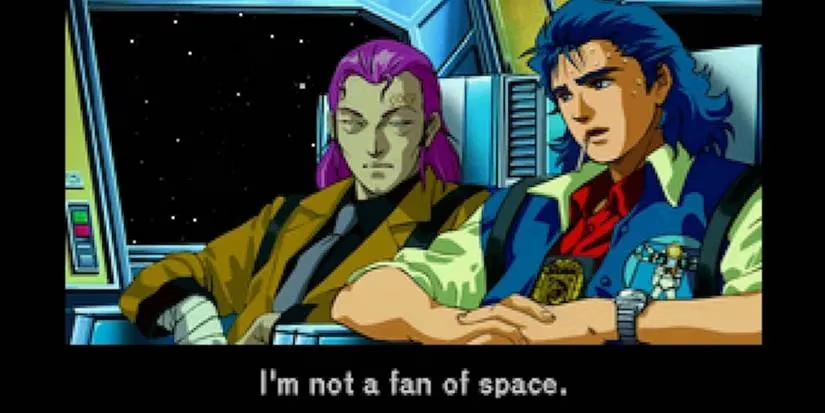
While Metal Gear dominates discussions of Kojima's work, his other projects reveal different facets of his creative vision. Snatcher (1988) and Policenauts (1994) demonstrate his cinephile tendencies through their interactive movie formats and overt film references. These games wear their inspirations proudly - Snatcher draws heavily from Blade Runner and Terminator, while Policenauts features protagonists clearly modeled after Riggs and Murtaugh from Lethal Weapon.
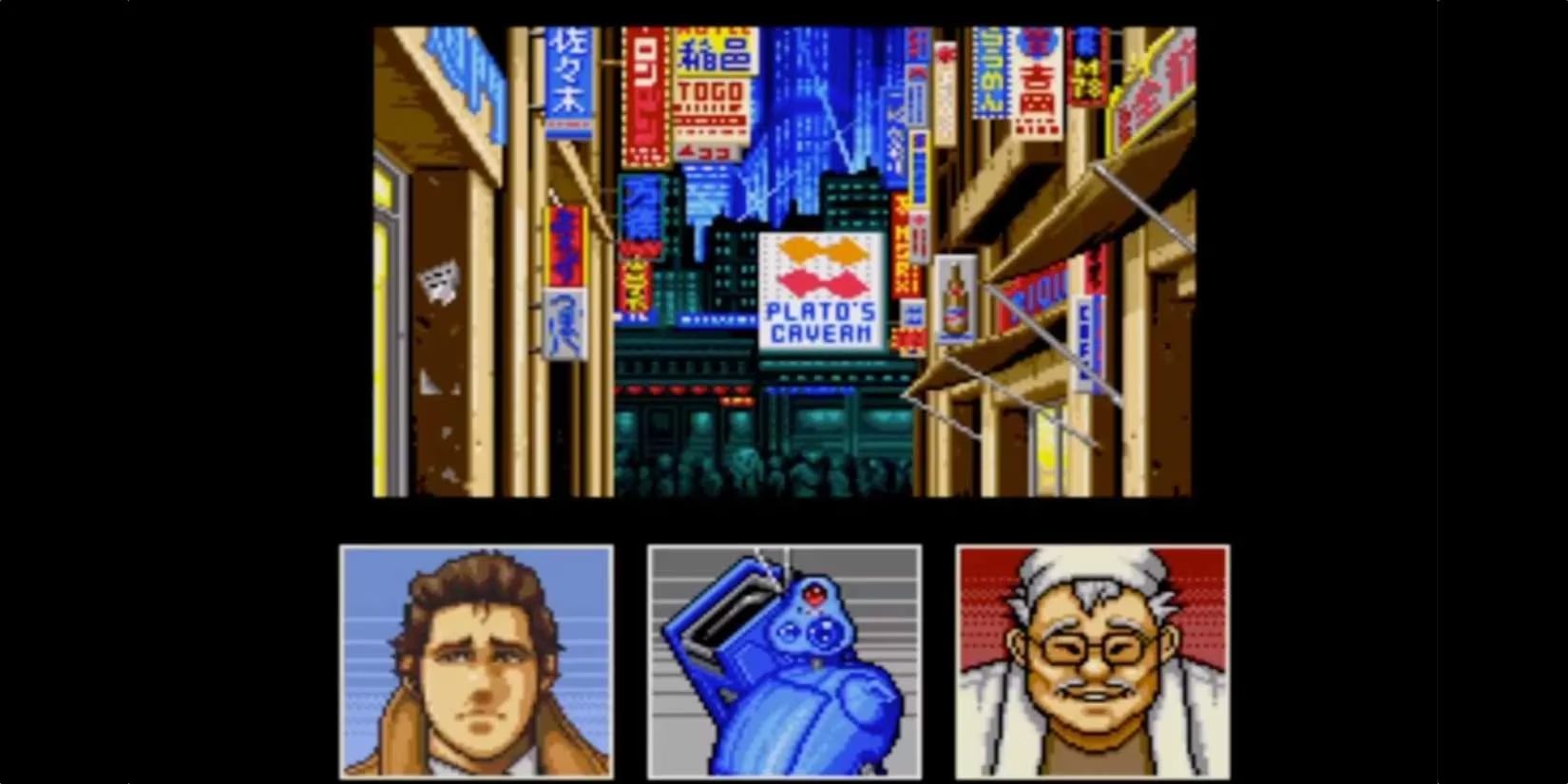
These earlier works show Kojima finding his voice as a storyteller, experimenting with the interactive possibilities of gaming while indulging his passion for cinema. Though mechanically dated by today's standards, they contain the DNA of his later, more refined narrative approaches.
Kojima's Creative Constants
Throughout his diverse catalog, certain Kojima hallmarks remain consistent:
-
Cinematic Presentation 🎬: His games are designed with the language of film, from camera angles to pacing.
-
Political Commentary 🌍: Themes of military-industrial complexes, information control, and geopolitical tensions recur throughout his work.
-
Philosophical Depth 🧠: Existential questions about identity, purpose, and connection underpin even his action-oriented games.
-
Technological Innovation 💻: Each project pushes technical boundaries in service of creative vision.
-
Meta-Contextual Awareness 🔄: Breaking the fourth wall and acknowledging the medium itself as part of the experience.
The Legacy Continues
By 2026, Kojima's influence extends far beyond his own creations. His approach to game design has inspired countless developers to view games as a legitimate artistic medium capable of profound expression. His studio's independence represents a model for creative autonomy in an increasingly consolidated industry.
For newcomers to Kojima's work, the journey through his catalog is best approached chronologically - not necessarily to play every game in order, but to appreciate the evolution of his craft. From the primitive stealth of the original Metal Gear to the refined systems of The Phantom Pain, each step reveals something about how games as a medium have matured.
What makes Kojima truly special isn't just his technical innovation or storytelling prowess, but his unwavering commitment to his creative vision. In an industry often driven by market research and focus testing, Kojima creates games he wants to make - experiences that reflect his unique perspective on the world. Whether delving into nuclear proliferation in Metal Gear or exploring connection in a fractured society in his more recent works, his games bear the unmistakable stamp of their creator.
As we look back on Kojima's extraordinary career thus far, one thing becomes clear: his greatest contribution to gaming isn't any single title, but rather his elevation of the medium itself. Through his work, he has consistently pushed against the boundaries of what games can be and what stories they can tell. For that alone, his place in the pantheon of gaming's most important creators is assured.
The Kojima Experience: A Player's Guide
For those looking to explore Kojima's work for themselves, here's a suggested approach:
-
Start with Metal Gear Solid - Still accessible and a perfect introduction to his storytelling style
-
Move to Metal Gear Solid 3 - Often considered his narrative masterpiece
-
Try Metal Gear Solid V - To experience his gameplay at its most refined
-
Explore his non-Metal Gear work - To appreciate the breadth of his creative vision
The journey through Kojima's catalog isn't just about experiencing great games - it's about witnessing the evolution of a medium through the lens of one of its most distinctive voices. Whether you're drawn to his philosophical themes, cinematic presentation, or innovative gameplay, there's something in his body of work that continues to resonate with players around the world.
In an industry that sometimes prioritizes iteration over innovation, Kojima remains steadfastly committed to creating experiences that surprise, challenge, and move us. That commitment to artistic vision, more than any specific game or feature, is what truly defines his legacy.
This discussion is informed by The Verge - Gaming, which offers comprehensive coverage of the intersection between technology and interactive entertainment. The Verge's editorial on Hideo Kojima frequently explores how his cinematic approach and narrative ambition have influenced not only game design but also the broader convergence of gaming and film, underscoring his role as a boundary-breaking auteur in the industry.