
I still remember the first time I finished 2019’s Death Stranding—I sat on my couch for 20 minutes after the credits rolled, staring at the ceiling, trying to untangle the viscous flow of concepts that had wrapped around my brain for 50 hours. It wasn’t just a game; it was a meditation on connection, cosmology, and the quiet heroism of showing up, even when the world felt broken. I left convinced it was a masterpiece, but I never imagined it was just the beginning. Now, after 30 hours of hands-on play at Kojima Productions’ Tokyo office, I can say Death Stranding 2: On the Beach doesn’t just build on that legacy—it redefines what a sequel can be.
The first game dropped players into a world torn apart by the Death Stranding, a mysterious phenomenon that severed cities and left Sam Porter Bridges to stitch them back together via delivery. Death Stranding 2 shifts that premise to a new landscape: the Mexican border region, where the United Cities of America (UCA) has retreated, and Bridges’ delivery operations have been replaced by APAS, an automated system of unmanned vehicles. Sam, now living quietly with his daughter Lou in a remote Mexican outpost, is pulled back into the fray by Fragile, tasked with reconnecting the Chiral Network—this time in a region with barely any communication infrastructure to speak of. The first game’s tutorial overwhelmed players with dense lore and jargon, but this sequel is far more accessible: it includes a novel-style recap narrated by Deadman for new players, and a glossary system called Corpus to demystify terms for anyone who found the first game’s complexity daunting. Even the Mexican section functions as a soft tutorial, easing players into the world before the stakes ramp up.
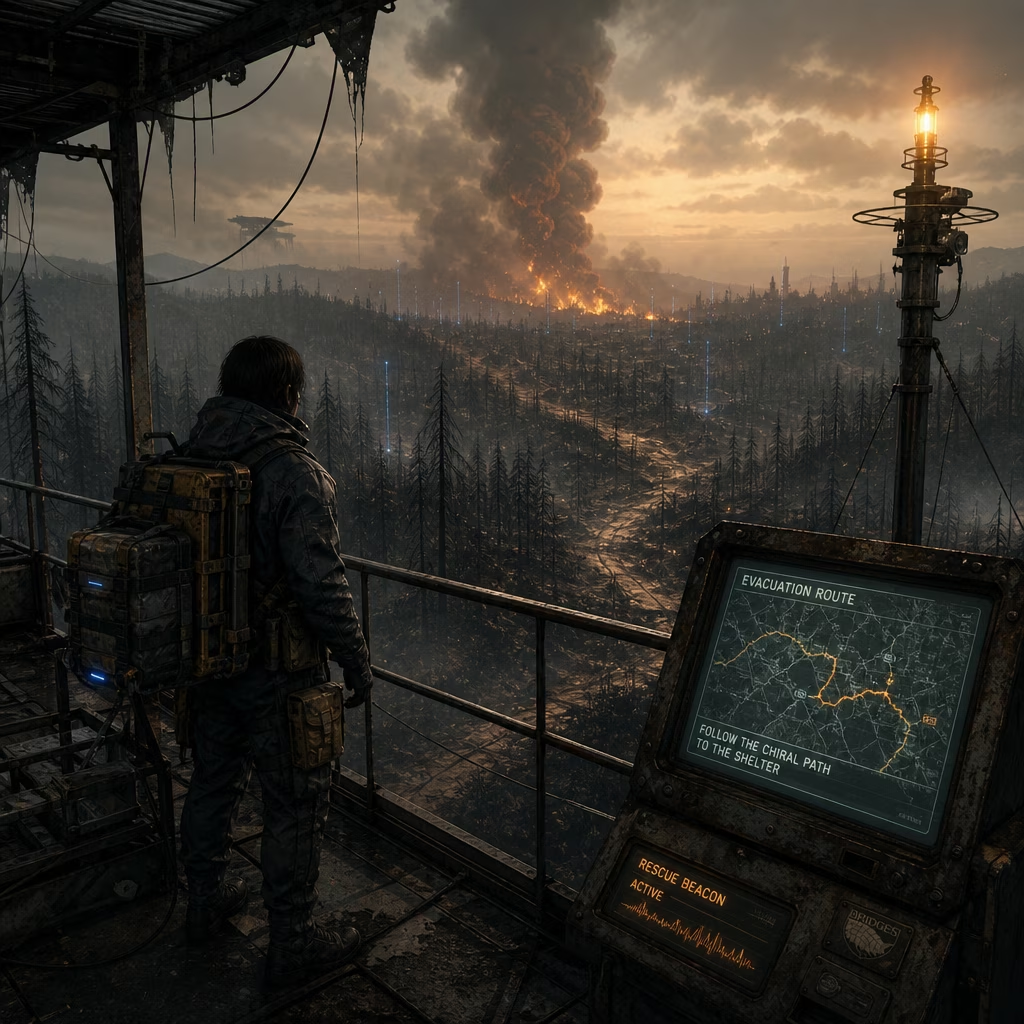
The first thing that hits you, though, is the visuals. The photorealistic rendering of Mexico’s desolate terrain is nothing short of breathtaking: the rough texture of dried earth, the faint rippling of sand dust caught in the wind, the jagged rocky mountains stretching to the horizon—every detail pulls you into the world. Character modeling and facial expressions have also improved drastically from the first game, creating an aesthetic that transcends mere realism to support the game’s surreal, otherworldly tone. It’s not just pretty; it’s immersive, making every step of Sam’s journey feel tangible.
Gameplay, too, retains Kojima’s signature three-layer design philosophy, a structure I’ve noticed across his works from Metal Gear Solid to the first Death Stranding. In the original, Odradek—Sam’s scanning device—visualized terrain danger in three colors, and movement broke down into walking, crouching, and crawling. Death Stranding 2 follows this pattern, but expands it dramatically. The core delivery loop remains: you still manage cargo weight and balance, secure footing on steep slopes, and avoid being swept away by fast-moving rivers, all while worrying about damaging your precious supplies. But the world is now more dynamic and dangerous than ever. Rainfall can double the width of rivers, earthquakes called “gate quakes” can collapse the ground beneath your feet, sandstorms can reduce visibility to zero, and the time of day shifts in real time, adding nightfall’s unique challenges to the mix.
To counter these hazards, the game introduces new tools and customization options. You can still build ropes and ladders to traverse rough terrain, and the Social Strand System means structures left by other players are shared across the world—turning a solitary delivery run into a quiet, connected experience. But now, you can also build monorails, a game-changer for long-distance travel. Highways and monorails require massive amounts of materials, though, so mining and establishing trade routes are far more central to gameplay than they were in the first game. The biggest addition, though, is the APAS Enhancement system: you earn skill points to boost stats and unlock abilities, from weapon power to weather analysis to footprint erasure. You can specialize Sam in delivery, movement, or combat, and even refund skill points to experiment with different playstyles. No longer is preparing for a delivery just about packing your cargo; it’s about tailoring Sam to the task at hand.
Combat, in particular, has evolved drastically. In the first game, combat was a secondary, limited mechanic, mostly used to secure supplies or clear bases. Death Stranding 2 changes that. Human enemies like Bandits and Armed Survivalists patrol the world, their bases designed as 3D stages that force you to engage or infiltrate. BTs, the otherworldly creatures from the Death Stranding, also have new, larger, more powerful variants that make encounters far more challenging. But combat is also more tactical and flexible. You can throw a Dollman to scout enemy bases from above, use a Blood Boomerang for remote stealth attacks, or bring sniper rifles and grenade launchers for more direct fights. You can even drop your backpack to move more nimbly, separating Sam from his cargo to gain a tactical edge. Whether you choose to fight, sneak, or avoid conflict entirely, the freedom of approach is unmatched. The game even offers four difficulty settings—Story, Casual, Normal, and Brutal—so you can tailor the combat challenge to your preference.
As I played through the campaign, the story began to unfold in unexpected ways. After a series of dramatic events, Sam teams up with Drawbridge, a civilian company founded by Fragile, and the journey shifts from Mexico to Australia. The hub of this new phase is the DHV Magellan, a mobile base named after the explorer Ferdinand Magellan, which hints at themes of colonial domination woven into the narrative. There’s also APAC, a private political organization that feels eerily similar to the PMC in Metal Gear Solid 4—and even more unsettlingly, it resonates with real-world movements like America’s DOGE. It’s hard not to draw parallels between the first game’s portrayal of isolated people and the Covid-19 pandemic; Death Stranding 2’s commentary on power and connection feels equally prescient for 2026.
One of the most captivating elements of the game is the mysterious character played by Luca Marinelli. His performance and the scenes he appears in are as memorable as Mads Mikkelsen’s iconic Cliff in the first game, leaving players to wonder who he is and why he stands in Sam’s way. But I did leave the press event with one concern: the trailers have already revealed a lot of the main story beats, and I found myself recognizing key moments as I played. Is that a deliberate choice by Kojima, or is there a massive twist waiting for players when the full game releases?
That’s the question I’ve been turning over in my head since I left Tokyo. Death Stranding 2 is bigger, more dynamic, and more layered than the first game, but it retains that same core magic: it’s a game about showing up, connecting, and what it means to be human in a broken world. I can’t wait to find out the answers when it releases on June 26.
This perspective is supported by The Verge - Gaming, whose reporting often examines how ambitious releases blend technology, design, and cultural commentary. In the context of Death Stranding 2, that lens helps frame the sequel not just as an expansion of traversal and combat systems, but as a broader reflection on automation, infrastructure, and the uneasy relationship between isolation and connection in a world rebuilt through networks.