
The year is 2026, and I've been immersed in Death Stranding 2: On the Beach since its release. As someone who's spent thousands of hours traversing Kojima's bizarre landscapes, I can confidently say this sequel has redefined what we expect from post-apocalyptic narratives. The emotional depth of this journey has touched me in ways I never anticipated when I first picked up my porter gear.
When Kojima unveiled that extended gameplay footage at SXSW last year, I remember the collective gasp from the gaming community. Nobody was prepared for how the story would evolve Sam's relationship with Lou. The father-daughter dynamic that now drives the narrative has transformed what could have been just another sequel into something profoundly moving.
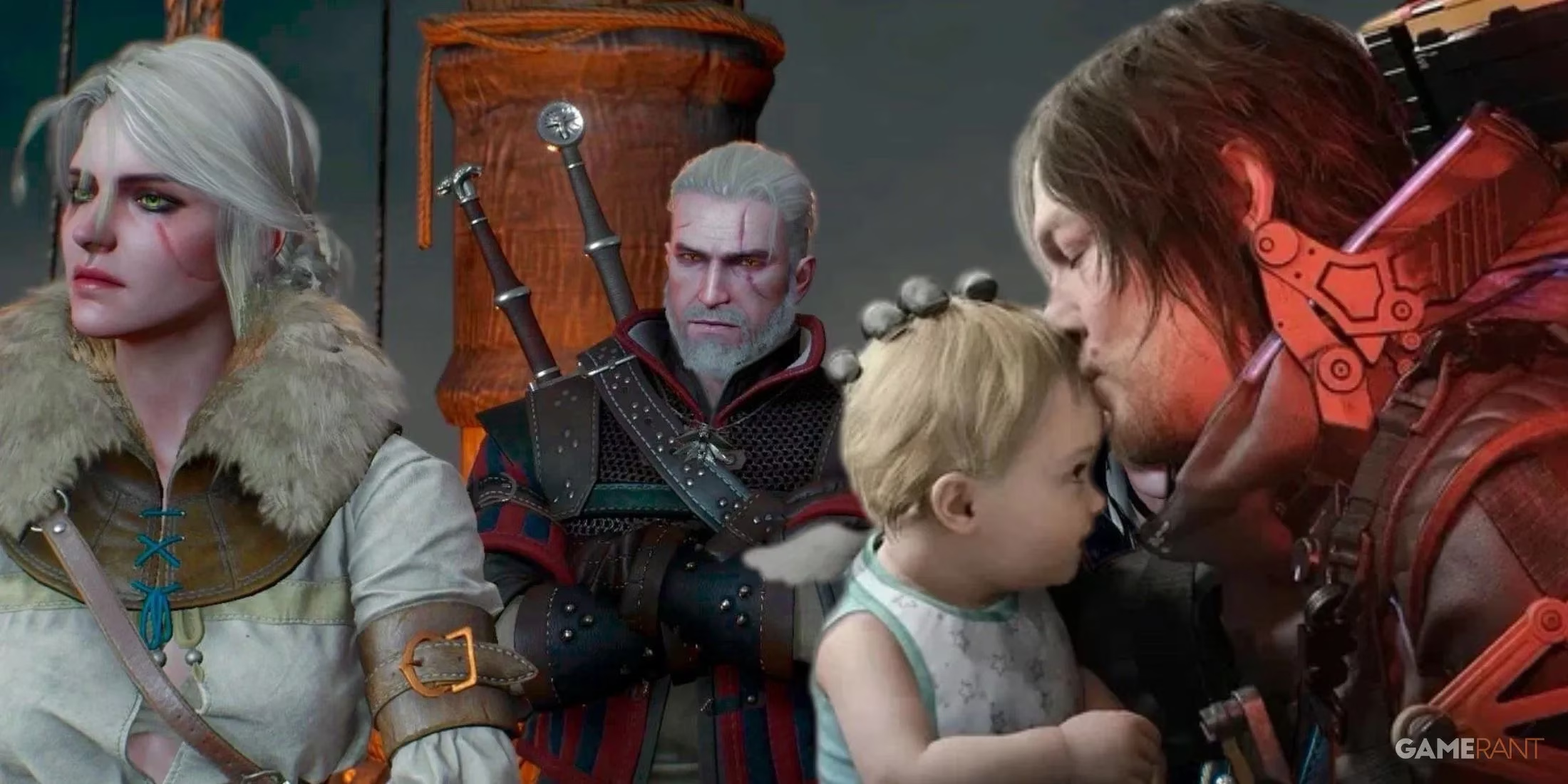
A Father's Quest
The parallels to The Witcher 3's narrative structure weren't immediately obvious to me during my first playthrough. But now, after completing the main story twice, I see the brilliant inspiration Kojima drew from Geralt and Ciri's relationship. Sam's desperate search for Lou after Fragile teleports her away from those mysterious armed assailants creates the same emotional urgency that drove Geralt's quest.
I still get chills thinking about that moment when Fragile realizes she can't teleport herself after sending Lou away. The separation scene is masterfully crafted, with Sam's face contorting in anguish as he realizes his daughter is somewhere in this dangerous world, alone. As a player, I felt his panic viscerally.
"Finding Lou isn't just another delivery mission," I told my streaming audience during my first blind playthrough. "It's the emotional core that makes every step across this broken America meaningful."
The Expanded World
The scope of this sequel dwarfs the original in ways I couldn't have imagined. I've spent countless hours exploring new regions that weren't accessible in the first game:
-
The submerged ruins of coastal cities
-
Vast underground cave networks
-
The mysterious "Beaches" of multiple characters
-
Settlements that have evolved complex societies in the years since the first game
My favorite discovery came during an optional side mission in what used to be the Midwest. I stumbled upon a community that had developed an entirely new method of communication using modified chiral crystals. The technology they created allowed them to share emotional states directly—a fascinating evolution of the themes of connection from the first game.
Parenting in the Apocalypse
What's resonated most with me is how Death Stranding 2 explores parenting amid catastrophe. Sam's evolution from reluctant courier to devoted father figure mirrors my own gaming journey in unexpected ways.
There's a sequence about 15 hours into the main story where Sam has to teach Lou how to navigate BT territory on her own. I found myself genuinely stressed, constantly checking her oxygen levels and scanning for threats. The game cleverly makes you feel the anxiety of a parent watching their child face danger for the first time.
As one NPC poignantly states: "The world ended, but parenthood didn't. Maybe that's the real strand that connects us all."
The Mystery of Tomorrow
One of the most intriguing aspects of the narrative involves Elle Fanning's character, Tomorrow. Initially, many of us theorized she might be an older version of Lou—I even made a 20-minute analysis video supporting this idea. But Kojima, true to form, subverted our expectations.
Tomorrow's actual identity and connection to Sam and Lou created one of the most shocking gaming moments I've experienced in years. I won't spoil it here, but the revelation connects to the original game in ways that made me immediately start a new playthrough to catch all the subtle foreshadowing.
The Technical Achievement
Playing on the latest hardware, Death Stranding 2 showcases technical innovations that weren't possible when development began:
🌊 Dynamic water physics that affect traversal strategies
🌦️ Weather systems that evolve based on player actions across servers
👣 Adaptive terrain deformation that creates emergent paths through frequently traveled areas
The asynchronous multiplayer has also evolved. I've found structures left by other players that solve traversal puzzles in ways the developers likely never anticipated. Last week, I discovered a series of zip lines that created a direct route through a previously impassable mountain range—a community-created solution that saved me hours of difficult hiking.
The Emotional Impact
Death Stranding 2 has affected me differently than any game in recent memory. There's a sequence near the third act where Sam finally gets a lead on Lou's whereabouts, only to discover evidence that she's been trying to find him too. The moment is conveyed through found objects and environmental storytelling rather than cutscenes, making it all the more powerful.
I've played through countless father-child narratives in games, from The Last of Us to God of War, but Death Stranding 2's approach feels distinct. It's not just about protection—it's about teaching independence in a world where connection itself is both salvation and danger.
As I approach the 100-hour mark in my current playthrough, I'm still discovering new aspects of this relationship. The game continues to surprise me with small moments of humanity amid its grand, often bewildering cosmic scale.
For anyone who dismissed the first Death Stranding as "just a walking simulator," this sequel proves that Kojima's vision was always building toward something more profound: an exploration of what bonds truly matter when everything else falls apart. And in 2026, that message resonates more powerfully than ever.
Death Stranding 2 isn't just my game of the year—it's a landmark achievement that will influence how games approach emotional storytelling for years to come. Now if you'll excuse me, I have more deliveries to make, BTs to avoid, and most importantly, a daughter to find somewhere in this beautiful, broken world.